Best Drones for Beginners UK 2026: 7 Easy-to-Fly Picks Ranked
Most “best beginner drone” lists are a wall of specs written by someone who’s never crashed one into a hedge. This one isn’t. A good first drone is light enough to fly under the loosest UK rules, forgiving enough to survive your early mistakes, and cheap enough that a stack into a fence post isn’t a disaster.
The single most useful number here is weight. Anything under 250g drops you into the friendliest slice of the Open category — the A1 subcategory, where you can fly closer to uninvolved people than a heavier drone lets you. (You’ll still need a free CAA Flyer ID for any drone from 100g up, so most of these do require it — the sub-250g win is the people-proximity freedom, not skipping the test.) That’s why six of the seven picks below are sub-250g, and it’s the first thing I’d weigh (literally) before buying.
Some links below are affiliate links. As an Amazon Associate we earn from qualifying purchases — at no extra cost to you. We only recommend kit worth flying.
The 30-second answer
If you want one drone that you won’t outgrow in a month, get the DJI Mini 4 Pro — it’s sub-250g, has obstacle sensing in every direction, and flies itself out of trouble. If you want the cheapest way to learn the sticks without crying over a broken drone, get the Holy Stone HS210 to practise indoors first. Everything in between is covered below.
Before you buy anything: whatever you pick, you’ll need a CAA Operator ID (and a Flyer ID for most of these). It’s quick and cheap, and it’s the law. We walk through the whole thing in the UK drone licence guide, and the current rules live in drone laws UK 2026.
1. DJI Mini 4 Pro — the one to buy if budget allows
This is the drone I hand people when they ask “what should I actually get.” It’s under 250g, so you’re flying in the A1 subcategory, where you can fly closer to people (you’ll still want the free Flyer ID, as it’s over 100g). But the reason it’s top isn’t the weight — it’s the omnidirectional obstacle sensing. It sees things in every direction and refuses to fly into them, which is exactly what a beginner needs. The camera shoots proper 4K HDR, the transmission holds a rock-solid link well past anything you’ll legally use, and flight time is long enough that you’re limited by your nerve, not the battery.
It’s a premium pick, and you’ll want the version with a screen controller so you’re not tethering your phone. But you will not outgrow this drone. It’s the last first-drone most people need.

DJI Mini 4 Pro (DJI RC-N2)
Sub-250g with omnidirectional obstacle sensing — the beginner drone you won't outgrow.
Check price on Amazon →Skip it if: you genuinely just want to muck about in the garden and film the dog. That’s overkill. Read on.
2. DJI Neo — the easiest drone to fly, full stop
The Neo is the most beginner-friendly drone DJI has ever made, and it’s the one I’d hand a nervous first-timer. It weighs 135g — miles under the 250g line — and it takes off from and lands in the palm of your hand. No sticks required for the basics: you tap a mode, it launches, films you, and comes back. Fully caged props mean bumping it into a wall is a non-event.
The trade-off is that it’s built for auto-follow and social clips more than deliberate cinematic flying, and it’s twitchier in wind because it’s so light. But as a “can I actually do this” confidence-builder, nothing else is close.

DJI Neo
135g, palm launch, fully caged — the easiest drone DJI has ever made to fly.
Check price on Amazon →3. DJI Flip — folding, caged, and properly capable
The Flip is the interesting middle child: it’s sub-250g like the Mini 4 Pro, it has full propeller guards built in like the Neo, and it folds down small. It’s the drone for someone who wants the palm-launch, no-fear ease of the Neo but with a real forward obstacle sensor and a bigger camera sensor that holds up better in low light. Flight time is generous for the class.
It only senses obstacles forwards, not in every direction, so it’s not quite the flying-itself-out-of-trouble machine the Mini 4 Pro is. But for the money it’s a lot of drone, and the built-in cage means you can fly it around people far more comfortably.

DJI Flip
Folding, sub-250g, built-in prop cage plus a forward sensor and a bigger sensor camera.
Check price on Amazon →4. DJI Mini 3 — the cheapest DJI camera drone worth owning
If the Mini 4 Pro is more than you want to spend but you still want that DJI stabilisation and camera quality, the Mini 3 is the honest answer. It’s sub-250g, has a proper 3-axis mechanical gimbal, shoots clean 4K, and has genuinely long flight time — longer than some newer models. What you lose versus the 4 Pro is the obstacle sensing, so you’re the collision-avoidance system now.
For a careful beginner flying in open spaces, that’s a fair trade. It’s a mid-range pick that punches well above it.

DJI Mini 3
The cheapest DJI with a real 3-axis gimbal and long flight time, minus the obstacle sensors.
Check price on Amazon →Skip it if: you know you’ll be flying close to trees, buildings or people — pay up for the sensors on the 4 Pro or the Flip.
5. Potensic Atom 2 — the best non-DJI drone here
Not everyone wants to buy DJI, and the Potensic Atom 2 is the one budget-brand drone I’d genuinely recommend. It’s sub-250g, has GPS (so it holds position and returns home instead of drifting off into next door’s garden), a stabilised camera, and a real controller with a proper transmission system rather than a phone-only wifi link that drops out at 40 metres.
GPS and return-to-home are the two features that separate a flyable drone from a toy, and the Atom 2 has both. It’s mid-range money for near-DJI capability. The ecosystem and app polish aren’t quite DJI-level, but the flying is genuinely good.
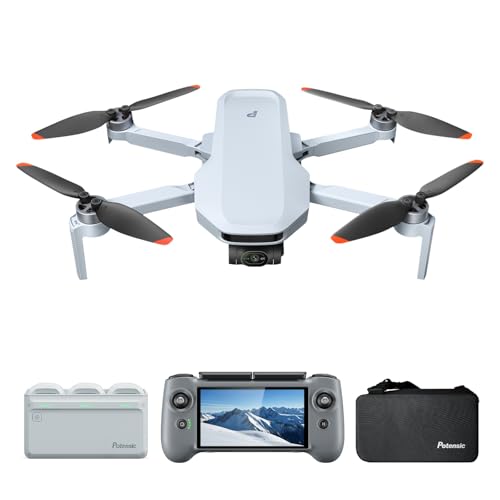
Potensic Atom 2 Fly More Combo
The one non-DJI pick worth it — sub-250g with real GPS, return-to-home and a proper controller.
Check price on Amazon →6. Holy Stone HS175D — budget GPS with a camera
The HS175D is the sensible entry to the true-budget tier. It has GPS, return-to-home, a foldable body and a 4K-ish camera, for meaningfully less than the DJI or Potensic picks. It’s the drone for someone who wants aerial photos and the safety of GPS lock without spending real money.
Be realistic about what you’re getting: the camera is fine, not great, the stabilisation is electronic rather than a proper gimbal, and it feels less refined in the air. But it has the features that matter for a safe first flight, which is more than most drones at this price can say.

Holy Stone HS175D
Budget GPS and return-to-home with a folding body — the sensible entry to the cheap tier.
Check price on Amazon →7. Holy Stone HS210 — learn the sticks before you spend
This one isn’t a camera drone and it’s barely a beginner drone — it’s a training tool, and that’s exactly why it’s on the list. The HS210 is a tiny palm-sized quad with prop guards that you can fly indoors on a wet day. There’s no GPS and no camera worth mentioning; it’s all manual sticks. Which is the point. Twenty minutes crashing this into your sofa teaches you throttle and yaw far cheaper than learning them on a £600 drone outdoors.
Buy it alongside a real drone, not instead of one. It’s the cheapest insurance policy in flying.

Holy Stone HS210 Mini Drone
A caged indoor trainer to learn throttle and yaw before you risk a pricey drone outdoors.
Check price on Amazon →How to choose in one sentence
Get the Mini 4 Pro if you can stretch to it, the Neo or Flip if you want fear-free flying, the Atom 2 if you’re avoiding DJI, and the HS210 to practise on regardless of what else you buy.
FAQ
Do I need a licence to fly a beginner drone in the UK?
You don’t need a “licence” in the pilot-exam sense for these, but you do legally need to register with the CAA. Any drone with a camera needs an Operator ID (£12.34 a year, and you label the drone with it), and any drone from 100g up — which is nearly all of these — needs a Flyer ID, a free online theory test. It takes about half an hour. Full walkthrough in our drone licence guide.
Why does 250g keep coming up?
Because it’s the weight that decides how close to people you can fly. Under 250g, you’re in the most permissive part of the Open category (A1) — you can fly closer to uninvolved people. At 250g and above, you move into the stricter A2/A3 rules and must keep more distance from people. That’s why nearly every drone here is deliberately just under the line. The Flyer ID is a separate thing: it’s required from 100g up regardless, so it’s not what the 250g line changes.
Can I fly a drone over my neighbour’s garden?
Short version: not really, and you can’t hover over their property filming either. There are privacy and nuisance rules that bite quickly. We cover exactly what’s allowed — and what to do if someone’s flying over yours — in can a drone fly over my garden.
How high can a beginner drone fly?
The legal ceiling is 120 metres (400 feet) above the surface in the Open category, and you must keep the drone in your direct line of sight at all times. Most of these drones can technically go higher and further, but doing so is illegal and, frankly, a great way to lose an expensive drone. Stay under 120m and where you can see it.
Is a DJI drone always the best beginner choice?
Usually, but not always. DJI’s flight software, stabilisation and safety features are ahead of the budget brands, which is why they dominate this list. But the Potensic Atom 2 closes the gap for less money, and a cheap Holy Stone is the right call for a kid or for indoor practice. Match the drone to how careful you’ll actually be, not to the badge.
The bottom line
Weight first, forgiveness second, camera third. If you buy for those in that order you’ll end up with a drone you keep flying instead of one that lives in a drawer after the first crash. And once you’ve got your Operator ID sorted, the sky — up to 120 metres of it — is yours.
If what you actually need is a roof or a survey shot done properly rather than a new hobby, it’s often cheaper and faster to hire a vetted pilot than to buy a drone and learn to fly it. Otherwise, pick from the seven above and go get your registration sorted.
More free beginner guides: how hard it is to fly a drone, your first-flight checklist, common beginner mistakes, do you need drone insurance, and the hidden costs of owning a drone.
Prices and availability live on Amazon and change often — always check the current price on the listing. Certain content on this page comes from Amazon and is provided "as is". As an Amazon Associate we earn from qualifying purchases.