Best Drone Landing Pads UK 2026: Cheap Kit That Saves Your Gimbal

A landing pad is a piece of folded fabric that costs less than a spare propeller and stops your gimbal ingesting the grit, grass clippings and wet mud that a hand-launch or a bare-ground takeoff throws straight into it. Prop wash at takeoff is a small sandstorm. Everything the downdraft lifts off the ground goes up, and some of it goes into the one moving optical assembly on your drone that costs a fortune to replace.
That’s the whole pitch. It’s not glamorous kit, nobody makes a YouTube thumbnail about it, and it’s the single best few quid you’ll spend on protecting a drone that cost you a few hundred. Below: how to size one, what actually matters, and the pads and cases worth folding into your bag.
Some links below are affiliate links. As an Amazon Associate we earn from qualifying purchases — at no extra cost to you. We only recommend kit worth flying.
How to size a landing pad
Two numbers matter: the pad’s diameter and your drone’s footprint with props spinning. Rule of thumb — the pad wants to be at least three times the diagonal of your drone so you’ve got margin for a scrappy GPS landing that drifts half a metre, and so the downwash still hits fabric rather than the ground beyond the edge.
- Sub-250g folders (DJI Mini 4 Pro, Mini 4K, Flip, Neo): a 50–55cm pad is plenty. Small, light, folds into a coat pocket.
- Larger camera drones (Air 3S and up): step up to 75cm so a GPS landing that lands a bit off-centre still touches down on the mat.
- You fly in wind, or you land manually a lot: go 110cm and stop worrying about it. The extra fabric is the whole point.
The other things that matter: double-sided (one bright side for visibility, one for a home-point the drone’s downward sensors can lock onto), waterproof coating so a damp field doesn’t soak through, and ground pegs so the thing doesn’t fold itself in half and take off the moment you spin the props up. A pad that blows away mid-launch is worse than no pad.
The all-round pick: STARTRC Landing Pad Pro
If you fly a Mini-class drone and want one pad that does everything without thinking about it, this is it. Double-sided, waterproof-coated, folds down to a disc that clips to a bag, and it’s sized right for the sub-250g crowd — the exact drones most people reading this actually own. It’s the pad I’d hand a first-time buyer and tell them to stop researching.

STARTRC Drone Landing Pad Pro
Double-sided, waterproof, sized right for sub-250g Minis — the one-pad answer for most flyers.
Check price on Amazon →The big one for windy days: REFLEX 110cm
When you’re landing manually in gusty conditions, or you’ve moved up to a larger drone, the 55cm pads start feeling like landing a helicopter on a dinner plate. This 44-inch quick-fold gives you the margin. Double-sided, waterproof, and big enough that a slightly sloppy touchdown still lands on fabric. Overkill for a Neo in the back garden — exactly right for a survey in a field with a breeze.

REFLEX 110cm Quick-Fold Landing Pad
44in of double-sided waterproof fabric for windy days and manual landings where 55cm feels tight.
Check price on Amazon →The pocket-sized option: 55cm compact helipad
The counter-argument to a big pad is that the best pad is the one you actually bring. A 55cm waterproof helipad folds to nothing, weighs almost nothing, and lives permanently in the drone bag so you never fly without one. For sub-250g flyers who mostly launch in calm conditions, this is the pragmatic buy — cheap enough to own two and leave one in the car.
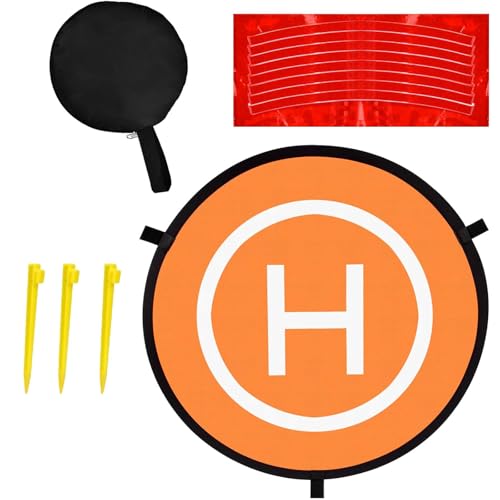
55cm Collapsible Waterproof Helipad
Folds to nothing and lives in the bag permanently — the pad you actually bring.
Check price on Amazon →For dusk flights: FPVtosky reflective pad
UK winter means you’re flying in near-dark from about 4pm. A reflective pad picks up your torch or the drone’s landing light so you can actually see your home point when the sun’s gone. If you shoot golden-hour or blue-hour photography — and if you own a drone, you will — the reflective panels earn their keep the first time you bring one down in the gloom.
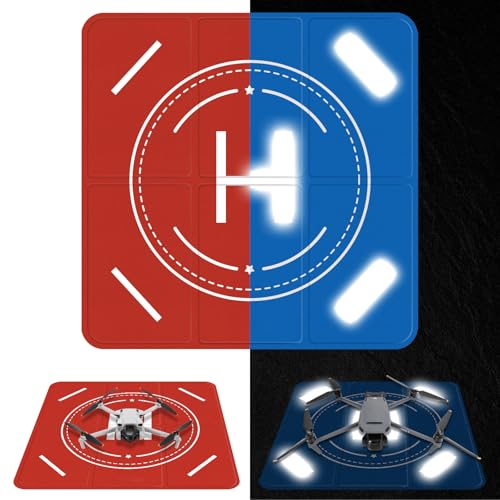
FPVtosky Reflective Landing Pad
Reflective panels catch your torch so you can spot your home point on winter dusk flights.
Check price on Amazon →Protect it between flights: LEKUFEE hard case
The pad protects the gimbal on takeoff; a hard case protects it every other minute the drone isn’t flying. Chucking a Mini into a rucksack next to your keys is how gimbals arrive bent. A moulded waterproof case with cut-outs for the drone, controller and a couple of batteries turns transport from a gamble into a non-event.

LEKUFEE Waterproof Hard Case for DJI Mini
Moulded cut-outs keep the gimbal safe in transit — where most Mini damage actually happens.
Check price on Amazon →While you’re at it: a spare battery
Every honest owner’s guide ends here, because a single battery gives you roughly 20-odd minutes of real-world flying before you’re packing up. A spare doubles your session and means a landing pad and a case actually get used more than once per trip. Genuine-spec batteries only — the cheap unbranded cells are a false economy and a fire risk you don’t want in your bag.

Spicula Mini 4 Pro Intelligent Flight Battery
Doubles your session; genuine-spec cell so you're not gambling with a bag fire.
Check price on Amazon →FAQ
Do I actually need a landing pad?
No law requires one. But if you ever hand-launch, land on grass, or take off from gravel or a dusty path, the pad is cheap insurance against a gimbal or motor failure that costs many times more. For the money, it’s the highest-return accessory you can buy.
What size landing pad for a DJI Mini?
50–55cm is plenty for a sub-250g Mini, Flip or Neo in calm conditions. Go 75cm if you land manually a lot or fly in wind, and 110cm if you want margin for a sloppy GPS touchdown on a breezy day.
Will a landing pad help my drone’s sensors?
A plain, high-contrast pad gives the downward vision sensors a clear surface to lock a home point onto, which can tighten up Return-to-Home accuracy. Avoid pads with busy reflective patterns as your home-point surface for that reason — though a reflective side is handy for spotting the pad in low light.
Do landing pads blow away?
Cheap ones do, which is exactly why the good ones ship with ground pegs. Peg it down before you spin up. A pad that folds in half and lifts off under prop wash is a hazard, not a help.
A landing pad, a case and a spare battery is the entire accessory kit most flyers need — everything past that is a want, not a need. If you’re only buying a drone to inspect your own roof rather than to fly for fun, read can I inspect my own roof with a drone first — the honest answer might save you the whole outlay.
More free flying-ground guides: whether you need a landing pad, taking off and landing safely, grass, gravel & sand surfaces, flying at the beach, and flying in wind.
Prices and availability live on Amazon and change often — always check the current price on the listing. Certain content on this page comes from Amazon and is provided "as is". As an Amazon Associate we earn from qualifying purchases.