DJI Flip vs DJI Mini: Which Should You Buy?
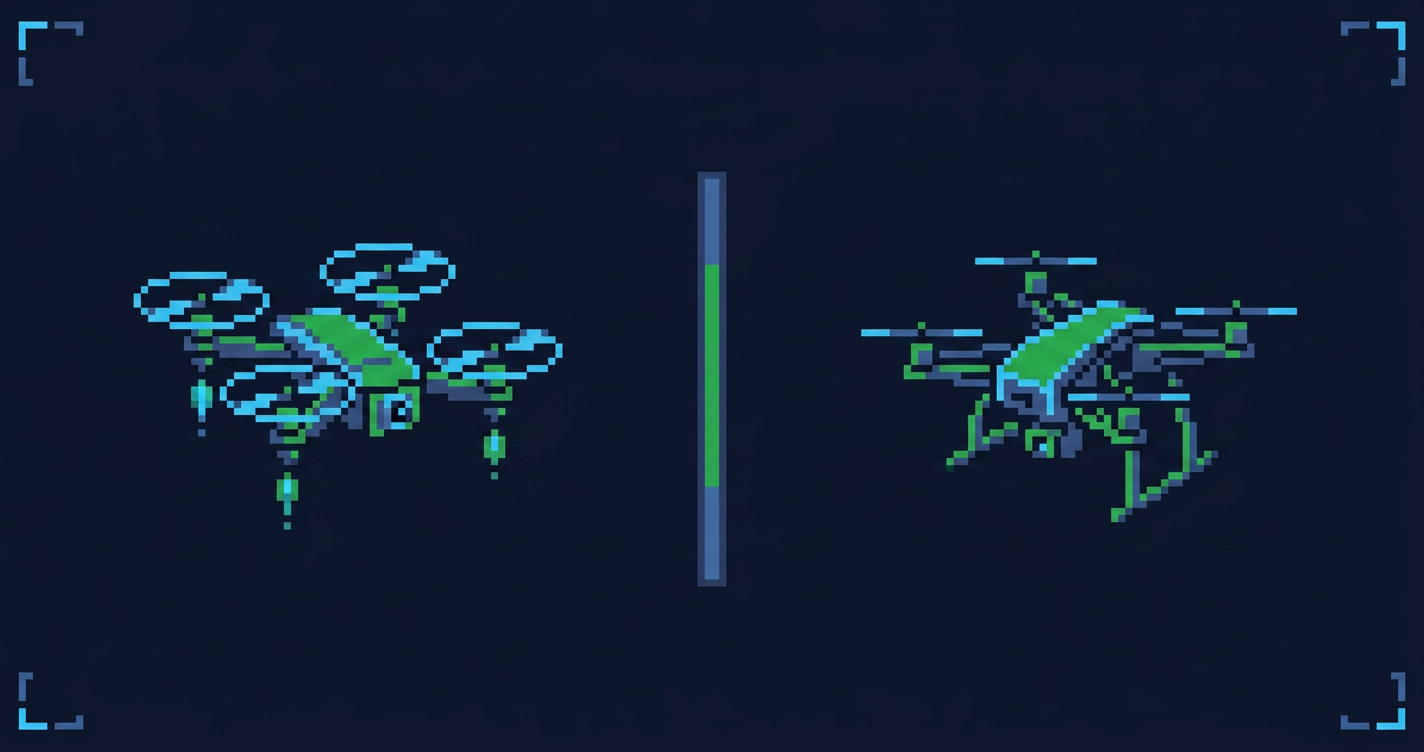
Here’s the short version: buy the DJI Flip if you want a safe, simple, hands-free drone you can fly near people and indoors without stress. Buy a DJI Mini if you want the most capable sub-250g camera drone DJI makes and you’re happy to fly it properly, in open sky, with a controller. They share a sensor and a weight class, so it’s tempting to treat them as the same drone at different prices. They aren’t — one is built around caged safety and self-flying, the other around open-air capability.
Both stay under 250g, so both fly in the relaxed A1 category — you can fly close to people and only briefly over them. But both weigh well over 100g and carry cameras, so both need a free CAA Flyer ID and a paid Operator ID (£12.34 a year). Here’s the honest breakdown.
The core difference: caged simplicity vs open capability
The Flip’s defining feature is its full-coverage propeller guards. The blades are enclosed the whole flight, so a bump into a wall, a person or a doorway does no harm. That, plus palm launch, makes it the drone you can hand to a nervous beginner or fly around a living room. The trade: the guards add drag, so real-world flight time runs shorter than the box claims and it’s pushed around sooner in wind.
A Mini has no guards. Its arms and blades are exposed, so it’s not the one you fly indoors or thread past people — but without that drag it flies longer, holds steadier in a breeze, and carries a full suite of obstacle sensing. The Mini is a proper open-sky camera drone; the Flip is a caged all-rounder. That single choice drives almost everything below, and it’s the same fork explained in folding vs non-folding drones.
Camera: closer than the price suggests
This is the surprise. The Flip and the current Mini 4 Pro use the same 1/1.3-inch sensor, so in good light their stills and 4K footage are genuinely comparable — you’re not paying the Mini premium for a better sensor here. Where the Mini pulls ahead is the gimbal: it rotates to a true vertical position, capturing upright clips at full quality, while the Flip crops for vertical and drops resolution to get there. DJI’s step-up Mini goes further with a larger one-inch sensor, a real image-quality gap for anyone who wants the best footage a featherweight can produce.
So on camera: for landscape 4K in daylight, they’re close. If you shoot a lot of vertical video, or want the best low-light and detail a sub-250g drone can give, the Mini earns its money — as DJI’s featherweight line-up makes clear. If daylight horizontal footage is your world, the Flip won’t feel like a compromise.
Flying, sensing and safety: they solve opposite problems
The Flip’s obstacle sensing points forward only, and — this is the important bit — it switches off during subject tracking. Follow shots are safe in an open field and risky near trees or fences, because the drone isn’t watching what it’s flying into. The upside is that the prop guards make it forgiving when something does go wrong close in.
A Mini takes the opposite approach: omnidirectional sensing that watches all around the drone, with advanced tracking that keeps avoidance running while it follows a subject. That makes a Mini the more confident tracker on a trail. Neither is “safer” outright — the Flip is safer near people and walls thanks to its cage; the Mini is safer in open space thanks to its sensors. If you fly in gusty conditions, it’s worth reading flying a drone in wind, because the Flip feels it first.
Ease and immediacy: the Flip’s home turf
The Flip is the easier drone to live with, full stop. Palm launch means no controller at all for the hands-free stuff — take off from your hand, let it track or run a QuickShot, catch it back out of the air. For someone who wants footage of themselves or the family with zero setup and no fear of the blades, nothing in the Mini line is this approachable.
A Mini rewards you for flying it like a drone: a controller, a bit of practice, framing shots yourself. More capable and more fun once you’re into it, but more to learn. If “just works, safely, straight away” is your priority, that’s the Flip. If “I want to grow into a proper camera drone” is the goal, that’s the Mini.
Price and who each is for
The Flip sits meaningfully below the Mini on price — a real gap, though figures shift with sales, so check current pricing before you commit. What the money buys is capability and open-air safety, not a better sensor in good light.
Buy the Flip if: you’re a nervous beginner or buying for a household; you’ll fly near people or indoors; you want hands-free footage with no controller; daylight horizontal video is your main use; and you’d rather spend less on a drone you’ll feel confident flying.
Buy a Mini if: you want the most capable sub-250g drone DJI makes; you shoot vertical video or care about low-light quality; you’ll fly in open sky and want all-round obstacle sensing; you’re happy with a controller; and longer flights and better wind-holding matter.
First-timer weighing this up? It’s worth glancing at how these sit against the pure selfie flyer in the Flip vs Neo 2 comparison, and everything featherweight in the best sub-250g drones roundup.
FAQ
Do the DJI Flip and DJI Mini use the same camera?
The Flip and the Mini 4 Pro share the same 1/1.3-inch sensor, so in good light their photos and 4K video are very close. The Mini adds a gimbal that rotates for true vertical video, and DJI’s larger step-up Mini moves to a bigger one-inch sensor for a real image-quality jump. For daylight horizontal footage, though, the Flip’s camera holds its own.
Is the DJI Flip or a DJI Mini better for a complete beginner?
The Flip, for most beginners. Its full-coverage prop guards, palm launch and hands-free modes make it far more forgiving, and it’s the one you can safely fly near people or indoors. A Mini is more capable but expects you to fly it properly with a controller in open space. Confidence first, capability second — that points to the Flip.
Which flies longer and better in wind, the Flip or a Mini?
A Mini, on both counts. The Flip’s prop guards add drag, which shortens real-world flight time below the headline figure and makes it more easily pushed around in a breeze. A guardless Mini flies longer per battery and holds a steadier frame in wind — worth weighing if you fly in typical British conditions.
What registration do the Flip and the Mini need in the UK?
Both need the same two things. Because each weighs over 100g, you must pass the free CAA Flyer ID theory test to fly either — that threshold dropped from 250g to 100g on 1 January 2026, so staying under 250g no longer skips it. And because both carry cameras, each also needs a CAA Operator ID (£12.34 a year) displayed on the aircraft. What staying under 250g does buy you is the relaxed A1 category: you can fly closer to uninvolved people than a heavier drone allows.
Whichever way you’re leaning, our DJI Flip vs DJI Neo 2 comparison is the best next read for pinning down which sub-250g DJI is right for you.