Folding vs Non-Folding Drones: Does It Matter?
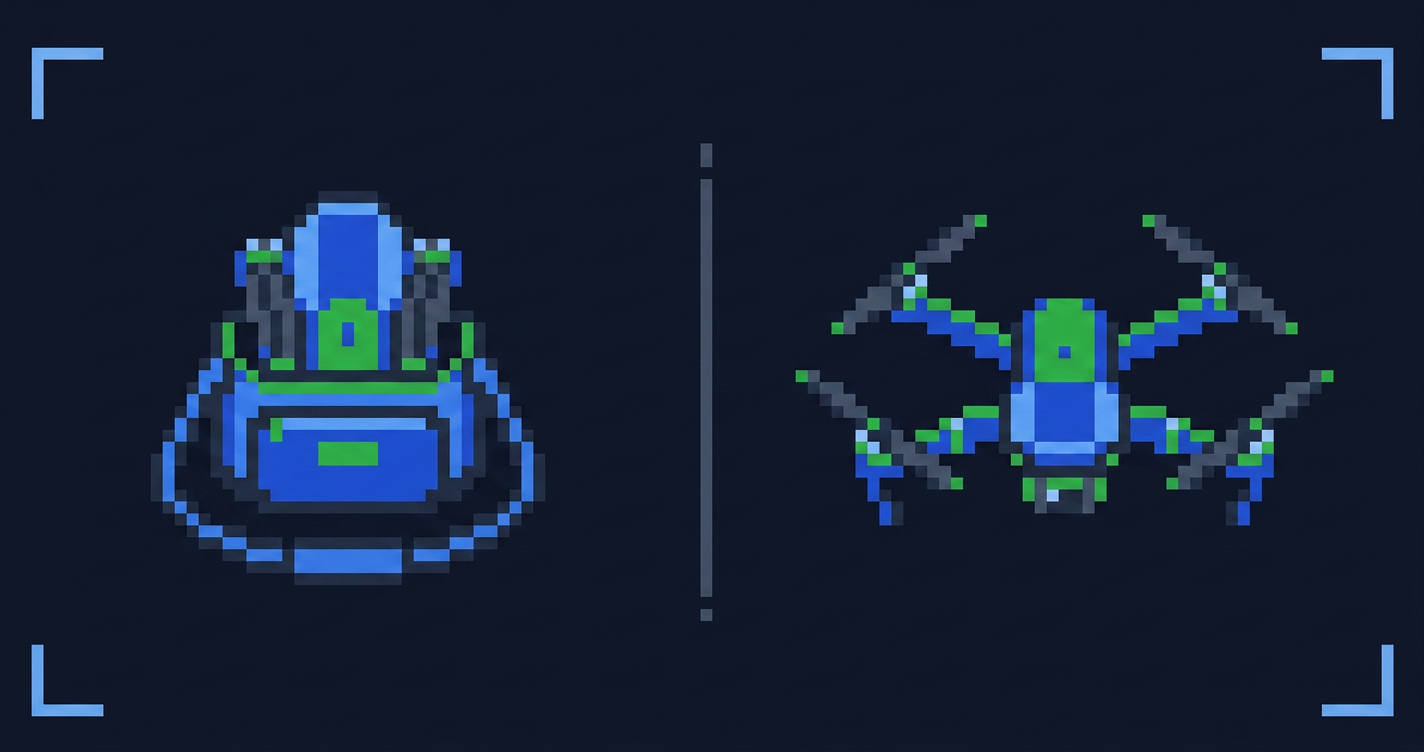
For most people the honest answer is: it matters less than the marketing suggests, and mostly in one direction. Folding arms let a drone pack down to something that slips into a jacket pocket or a corner of a day bag, and that’s a real advantage — a drone you’ll actually carry is a drone you’ll actually fly. But folding isn’t free. Every hinge is a moving part that adds a little cost, weight, and one more thing that can wear. Whether that trade lands in your favour depends almost entirely on how and where you fly.
Here’s what folding buys you, what it costs, and how to tell which side of the line your flying sits on.
What folding actually buys you: it’s about carrying, not flying
A folding drone flies no better than a rigid one. The arms don’t do anything clever in the air — they just tuck in against the body so the whole thing collapses to a fraction of its flying size. DJI’s mini drones fold to roughly the footprint of a chunky phone; the DJI Flip goes further and folds its propellers down to stack flat as well.
The payoff is purely about getting the drone to where you fly it. A folded mini rides in a coat pocket or the map pocket of a rucksack; a non-folding drone of the same capability needs a dedicated case. On a hike, a city break or a walk to the park, that difference decides whether the drone comes with you or stays on a shelf. For a hobby drone, that’s the whole game — the best camera is the one you have on you.
What folding costs you: hinges, weight and a little money
Nothing mechanical is free. Folding arms are hinges, and hinges are the part most likely to develop play over years of use — a tiny wobble at the joint, a fold that doesn’t click home crisply. In practice modern DJI hinges are well made and rarely fail within a normal drone’s lifespan, so this is a durability footnote rather than a warning. But it’s real, and a rigid-arm drone has one less thing to loosen.
Folding also adds a gram or two versus a hypothetically identical fixed-arm design — trivial on its own, but every gram matters when a drone is engineered to sit just under the 250g line that unlocks the UK’s lightest rules. And there’s a small habit cost: an extra fold-out-the-arms step before every flight. Not slow, just not instant. A pure selfie drone that launches straight off your palm skips even that.
Where the durability question really lives
It’s tempting to assume rigid means tougher, and in raw structural terms a one-piece frame is harder to damage than a jointed one. But that misreads where drones break. The arm hinge is almost never what fails in a crash — it’s the propellers, the gimbal and the camera, none of which folding has any bearing on.
If durability is your priority, the feature that matters isn’t rigid arms — it’s prop guards. A drone with full-coverage guards, like the Flip or the palm-launch Neo 2, survives clips and bumps that would shred a bare-bladed drone, folding or not. So “which is more robust” is really two questions: hinges (a minor long-term wear point) and crash protection (down to guards, not the frame). Don’t let the folding-versus-rigid framing distract from the one that matters.
So when does folding actually matter?
Break it down by how you fly:
- You travel, hike or fly away from the car. Folding matters a lot. Pack-down size is the difference between the drone coming along and staying home — which is why most mainstream camera drones fold.
- You fly close to home, from a fixed spot, or indoors. Folding barely matters. If the drone lives in a bag in the boot and flies from the same field each week, packed size is almost irrelevant — pick on camera, flight time and prop guards instead.
- You want the simplest grab-and-go. A palm-launch selfie drone with no arms to unfold and no controller to power up wins on sheer immediacy, if you can live with its smaller camera.
- You’re buying for a child or a nervous beginner. Prop guards and ease of launch outrank folding entirely. Portability is a distant concern next to not slicing a finger or crashing on take-off.
For most buyers the takeaway is simple: folding is a genuine plus if you carry your drone anywhere, a non-issue if you don’t, and never the spec to lose sleep over. The camera, the obstacle sensing and the guards decide whether you enjoy the drone. Folding just decides how easily it gets to the field.
The bottom line
Buy a folding drone if you’ll ever carry it further than the back garden — which is nearly everyone. Don’t pay a premium chasing “rigid = tougher,” because that’s not where drones break. And don’t let folding overshadow the specs that shape every flight. When two sub-250g drones are otherwise close, the fold is a tiebreaker, not the headline. If you’re deciding between DJI’s caged folding flyer and a full camera mini, that call is worked through in our Flip vs Mini guide; if it’s the Flip against the hand-launch selfie drone, the Flip vs Neo 2 comparison covers it. Weighing up the whole featherweight class? The sub-250g roundup sorts them out.
FAQ
Do folding drones fly worse than non-folding ones?
No. Folding arms tuck away for transport and lock rigid in flight — the drone handles exactly the same in the air as a fixed-arm equivalent. The folding mechanism does nothing while you’re flying. Any performance difference between two drones comes from motors, camera and software, not from whether the arms fold.
Are folding drones less durable because of the hinges?
Slightly, in theory, over years of use — a hinge is one more part that can develop a little play. In practice modern hinges are well made and rarely the thing that fails. Crashes almost always break propellers, gimbal or camera, none of which folding affects. If you want crash resistance, look for prop guards, not rigid arms.
Is a folding drone worth it if I only fly near home?
Not especially. Folding’s whole benefit is pack-down size for carrying, so if your drone lives in a bag in the boot and flies from the same spot each week, that benefit barely applies. Choose instead on camera quality, flight time and prop guards, and treat folding as a minor bonus.
Does folding help a drone stay under 250g?
Folding itself adds a gram or two rather than saving weight. But because the sub-250g line is where the UK’s lightest flying rules kick in, every design choice on a featherweight drone is a fight for grams. Manufacturers keep folding minis under the limit by trimming weight elsewhere — the fold is a portability feature, not a weight-saving one.
Still torn between the caged folding Flip and a full camera mini? Our DJI Flip vs DJI Neo 2 comparison is the clearest place to settle which sub-250g drone actually fits you.